8 May 2025 By The Big Minds
Game Report
The Evolve or Extinct Game created by The big Minds Group
Science | Biology | Project
Commentary
Opinion
Insight and Analysis
Blogs
Get our alerts
The big minds Blog
8 May 2025 By The Big Minds
Game Report
Science | Biology | Project

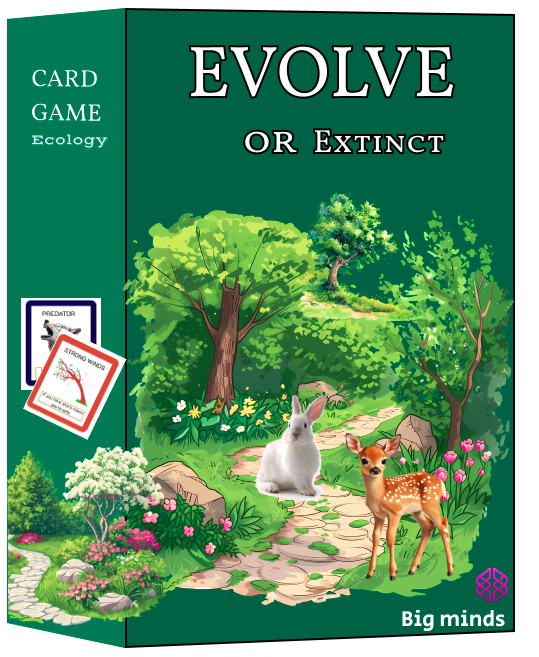
In designing Evolve or Extinct, the central goal was to teach evolutionary biology, focusing on adaptation, natural selection and environmental pressures. These are foundational concepts in life sciences that are often difficult to visualize or explain to young learners. To communicate these ideas effectively, we used simple, intuitive game mechanics where each player becomes an animal trying to survive in the wild.
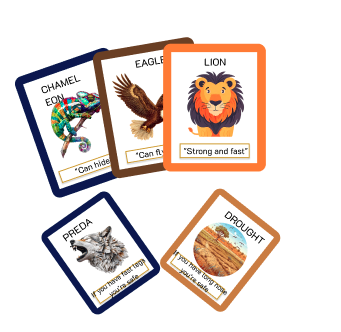
Animal Cards represent real species, encouraging players to connect with biodiversity. Trait Cards symbolize inherited traits (like “Camouflage” or “Fast Legs”) that help an animal survive environmental dangers. Danger Cards simulate ecological challenges (such as droughts, predators, and ice storms), showing how survival is tied to having the right traits at the right time. By surviving dangers or collecting useful traits, players experience a simplified version of how species evolve to meet environmental demands.
We simplified complex ideas like gene expression, reproductive success, and population dynamics into cause effect relationships that are easy to grasp. For example: Having Camouflage protects you from a Predator Attack. Not having a useful trait means losing a “life” (representing death or extinction risk). This clear linkage helps players internalize how specific traits provide survival advantages. We avoided technical terms and focused on intuitive understanding. Instead of explaining natural selection in a textbook way, we allow players to feel the impact of selection through gameplay. Tokens represent limited resources, encouraging strategic decision making, just like organisms must make trade offs in nature.
Playstations
We conducted several playtests with students and received helpful feedback:
.png)
Confusion about which traits matched which dangers: Some players had difficulty remembering what each trait did.

2. Randomness Felt Unfair: Players who received less helpful traits early felt at a disadvantage.

3. Games Ended Too Quickly: Some players were eliminated quickly, which made the game less fun.
Response: We added symbols or quick reference text to cards (e.g: “Fast Legs – helps vs fire, predators, drought”) to make matching easier.
Response: We introduced a token economy , allowing players to buy Trait Cards using tokens. This added strategy and reduced reliance on luck.
Response: We added an alternate win condition collecting five traits so players could focus on “evolving” even if they faced early danger.
In conclusion, Evolve or Extinct! simplifies evolution into an engaging experience that’s accessible to
young learners. Through choices, survival, and consequences, the game builds a foundational
understanding of how traits affect an organism’s survival. By blending storytelling, decision making,
and science, the game becomes a powerful tool for science communication, encouraging both learning and
curiosity about the natural world.